Industrial Steel Band Saw
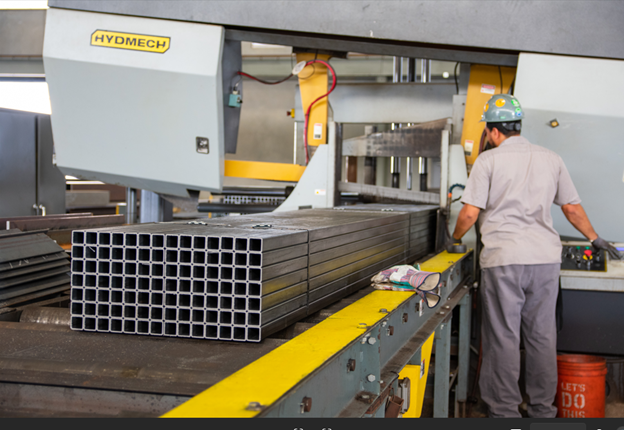
An industrial steel band saw is a heavy-duty cutting machine used to cut metal—such as round bar, square bar, pipe, tubing, and structural shapes. It uses a continuous loop blade with teeth to make straight or angled cuts through solid metal stock.
Here’s how it works:
1. Main Components
An industrial metal-cutting bandsaw typically includes:
-
Blade – A continuous loop of toothed steel (often bi-metal or carbide tipped).
-
Drive wheels – Two large wheels that rotate and carry the blade in a loop.
-
Motor and gearbox – Powers the blade at controlled speeds.
-
Blade guides – Keep the blade aligned and stable during cutting.
-
Vise or clamping system – Holds the material securely in place.
-
Hydraulic feed system – Controls how fast the blade lowers into the material.
-
Coolant system – Pumps cutting fluid onto the blade and workpiece.
-
Control panel – Allows the operator to set speed, feed rate, and cycle functions.
2. The Blade Loop and Motion
The blade is welded into a continuous loop and mounted around two wheels:
-
One wheel is powered by the motor.
-
The other wheel acts as an idler to maintain tension.
When the motor runs, it rotates the drive wheel, which moves the blade in one direction continuously. The teeth on the blade cut only in the forward direction.
Unlike circular saws that spin a rigid blade, a bandsaw uses a flexible blade under tension, allowing for smoother and more controlled cutting.
3. Securing the Material
Before cutting:
-
The operator places the steel (round bar, square bar, pipe, etc.) in the vise.
-
The vise clamps down tightly to prevent movement.
-
The operator sets the cut length or angle (if applicable).
In automatic models, the machine can index material forward for repeated cuts.
4. Controlled Cutting Action
Industrial steel bandsaws use a downward cutting motion:
-
The saw head (which contains the blade and motor) lowers slowly onto the material.
-
A hydraulic feed system controls the downward pressure and speed.
-
The operator sets the feed rate based on material type and size.
The blade teeth remove small chips of metal with each pass. Proper feed rate is critical:
-
Too fast → blade damage or tooth stripping.
-
Too slow → excessive heat and blade dulling.
5. Blade Speed and Tooth Selection
Metal-cutting bandsaws operate at much slower speeds than wood bandsaws. Blade speed is measured in surface feet per minute (SFM).
Different materials require different speeds:
-
Mild steel → moderate speed
-
Stainless steel → slower speed
-
Aluminum → faster speed
Blade tooth pitch (teeth per inch, TPI) is selected based on material thickness:
-
Thin material → higher TPI
-
Thick solids → lower TPI
Proper tooth engagement ensures smooth cuts and longer blade life.
6. Coolant System
Cutting steel generates heat and friction. Industrial bandsaws use a coolant system to:
-
Reduce heat
-
Lubricate the blade
-
Flush metal chips away from the cut
-
Extend blade life
Coolant continuously flows over the blade and cut area during operation.
7. Types of Industrial Steel Bandsaws
Horizontal Bandsaw
-
Most common in metal shops.
-
Blade cuts downward into stationary material.
-
Ideal for cutting bar stock and structural steel.
Vertical Bandsaw
-
Blade remains vertical and stationary.
-
Operator moves material into blade.
-
Used more for contour cutting or fabrication work.
Automatic Bandsaw
-
Feeds material automatically.
-
Makes repeated cuts with minimal operator involvement.
-
Common in production environments.
8. Why Bandsaws Are Preferred for Steel
Industrial bandsaws are widely used because they:
-
Produce straight, accurate cuts
-
Waste less material (thin kerf)
-
Operate more quietly than abrasive saws
-
Create less heat distortion
-
Are safer than many high-speed cutting tools
They are commonly used in steel service centers, fabrication shops, manufacturing plants, and construction supply operations.
In Simple Terms
An industrial steel bandsaw works by moving a continuous loop blade across steel at controlled speed and pressure. The blade teeth gradually remove metal while coolant reduces heat. A hydraulic system ensures steady cutting force, resulting in clean, precise cuts.
Helpful Links
Categories: Services