Square, Rectangular, and Round Mechanical Tubing
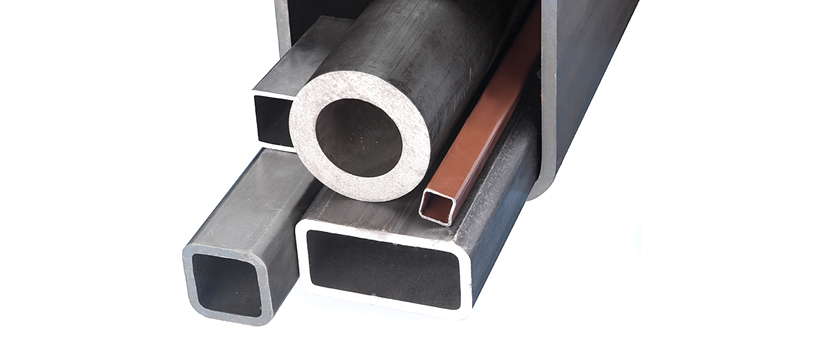
A closer look at the shapes, strengths, and uses of mechanical tubing.
Steel mechanical tubing is a versatile, high-strength material used across manufacturing, construction, transportation, agriculture, and industrial equipment. Unlike standard pipe, which is primarily designed to carry fluids and gases, mechanical tubing is engineered for structural and mechanical applications where strength, dimensional accuracy, and surface finish are critical. The three most common shapes are square, rectangular, and round tubing, each offering distinct advantages depending on the application.
What Is Mechanical Tubing?
Mechanical tubing is hollow steel product manufactured to precise outside dimensions (OD) and wall thicknesses. It is commonly produced through:
-
Electric Resistance Welding (ERW) – Formed from flat steel strip rolled into shape and welded longitudinally.
-
Drawn Over Mandrel (DOM) – An ERW tube that is cold drawn through a die and mandrel to improve dimensional tolerance, surface finish, and mechanical properties.
Mechanical tubing is typically specified by outside dimension and wall thickness, rather than nominal pipe size. It is valued for:
-
Tight dimensional tolerances
-
Consistent wall thickness
-
Good weldability
-
Excellent strength-to-weight ratio
-
Smooth surface finish
Square Mechanical Tubing
Square steel tubing features four equal sides and sharp or slightly radiused corners. It is widely used in structural frameworks, equipment supports, and fabrication projects.
Advantages:
-
High resistance to bending in multiple directions
-
Flat surfaces for easy welding and fabrication
-
Clean, modern appearance for architectural uses
-
Efficient load distribution in frame construction
Common Applications:
-
Equipment frames
-
Machine guards
-
Support structures
-
Agricultural implements
-
Trailers and racks
-
Fencing and gates
Square tubing is often chosen when equal strength is needed in both horizontal and vertical directions.
Rectangular Mechanical Tubing
Rectangular steel tubing has unequal side dimensions, allowing designers to optimize strength in one direction while reducing weight in another.
Advantages:
-
Higher moment of inertia in one axis (stronger in a preferred direction)
-
Efficient structural performance
-
Flat surfaces for welding and bolting
-
Ideal for long spans or beams
Common Applications:
-
Structural supports and beams
-
Vehicle frames and chassis
-
Material handling equipment
-
Platforms and mezzanines
-
Construction framing
Because of its shape, rectangular tubing is often used where bending stress is greater in one direction—such as horizontal supports.
Round Mechanical Tubing
Round steel tubing is cylindrical and provides uniform strength in all directions. It is commonly used in mechanical systems, load-bearing components, and fluid-related applications (when not requiring pipe specification).
Advantages:
-
Even stress distribution
-
Excellent resistance to torsion (twisting)
-
Smooth exterior for aesthetic or aerodynamic applications
-
Efficient for pressurized systems (when applicable)
Common Applications:
-
Roll cages and structural supports
-
Shafts and mechanical components
-
Handrails and guardrails
-
Hydraulic cylinders
-
Agricultural and industrial equipment
Round tubing is often selected when torsional strength and uniform load distribution are important.
Grades and Finishes
Mechanical tubing is available in various steel grades, such as:
-
A513 (ERW mechanical tubing)
-
A500 (structural tubing)
-
1020 / 1026 DOM tubing
Finishes may include:
-
Hot rolled
-
Cold rolled
-
DOM (cold drawn)
-
Galvanized (for corrosion resistance)
Material selection depends on strength requirements, machining needs, weldability, and environmental exposure.
Choosing the Right Shape
The choice between square, rectangular, and round mechanical tubing depends on the project’s structural demands:
-
Round tubing → Best for torsional loads and uniform stress distribution.
-
Square tubing → Ideal for balanced structural support and ease of fabrication.
-
Rectangular tubing → Efficient for directional strength and beam applications.
All three shapes provide excellent strength-to-weight performance compared to solid bar, making mechanical tubing a cost-effective and material-efficient solution.
Helpful Links
Categories: Steel Products