Confused by Pipe Size and Schedule?
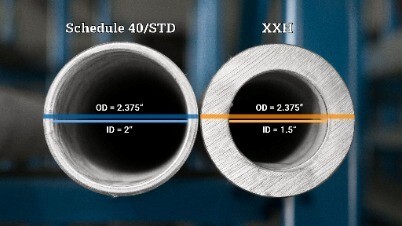
Pipe sizes and schedules can seem confusing at first, but once you understand one simple rule, everything starts to make sense.
No matter which pipe schedule you choose, steel pipe of the same nominal pipe size (NPS) always has the same outside diameter. Whether you're working with Schedule 10, Schedule 40, Schedule 80, or even heavier wall pipe, the outside dimensions remain constant.
What changes is the wall thickness. As the pipe wall becomes thicker, the inside diameter becomes smaller. This allows the pipe to withstand higher internal pressures while still using the same flanges, fittings, valves, and threaded or welded connections designed for that nominal size. This standardized sizing is one of the reasons steel pipe systems are so versatile and easy to design, modify, and maintain.
For example, a 2-inch nominal steel pipe has the same outside diameter regardless of whether it is Schedule 40 or Schedule 80. The Schedule 80 pipe simply has thicker walls, resulting in a smaller inside diameter and a higher pressure rating than its Schedule 40 counterpart.
The same principle applies to square and rectangular steel tubing. A piece of 2" × 2" square tubing measures 2 inches on the outside whether it has a 1/8", 3/16", or 1/4" wall. Increasing the wall thickness reduces the inside dimensions while keeping the outside size unchanged. This makes it easy to maintain consistent overall dimensions while selecting the wall thickness that provides the strength and load-bearing capacity your project requires.
Understanding this simple sizing rule makes it much easier to select the right material for your application. Whether you're building a structural frame, fabricating equipment, or installing a piping system, choosing the proper wall thickness ensures you get the performance you need without changing the overall outside dimensions of the material.