Steel Gauge Size - What's it all about?
Steel Gauge Sizes: Where Did They Come From?
If you've ever shopped for sheet metal, you've probably wondered why 10 gauge steel is thicker than 16 gauge steel, or why 18 gauge galvanized steel isn't the same thickness as 18 gauge stainless steel. It seems backwards—until you understand the history behind the gauge system.
The truth is, steel gauge sizing wasn't developed by engineers with a mathematical formula. Instead, it evolved from manufacturing practices that date back more than 150 years.
The Origins of Gauge Numbers
Long before modern rolling mills could produce sheet steel to precise thicknesses, metal was made by repeatedly passing it through rollers. Each pass through the rollers made the metal a little thinner.
A thick piece of metal required only a few passes through the mill, while a thinner sheet required many more. Manufacturers began referring to material by the number of rolling operations, or "gauges," it had undergone.
While the exact process varied between mills, the basic idea remained the same:
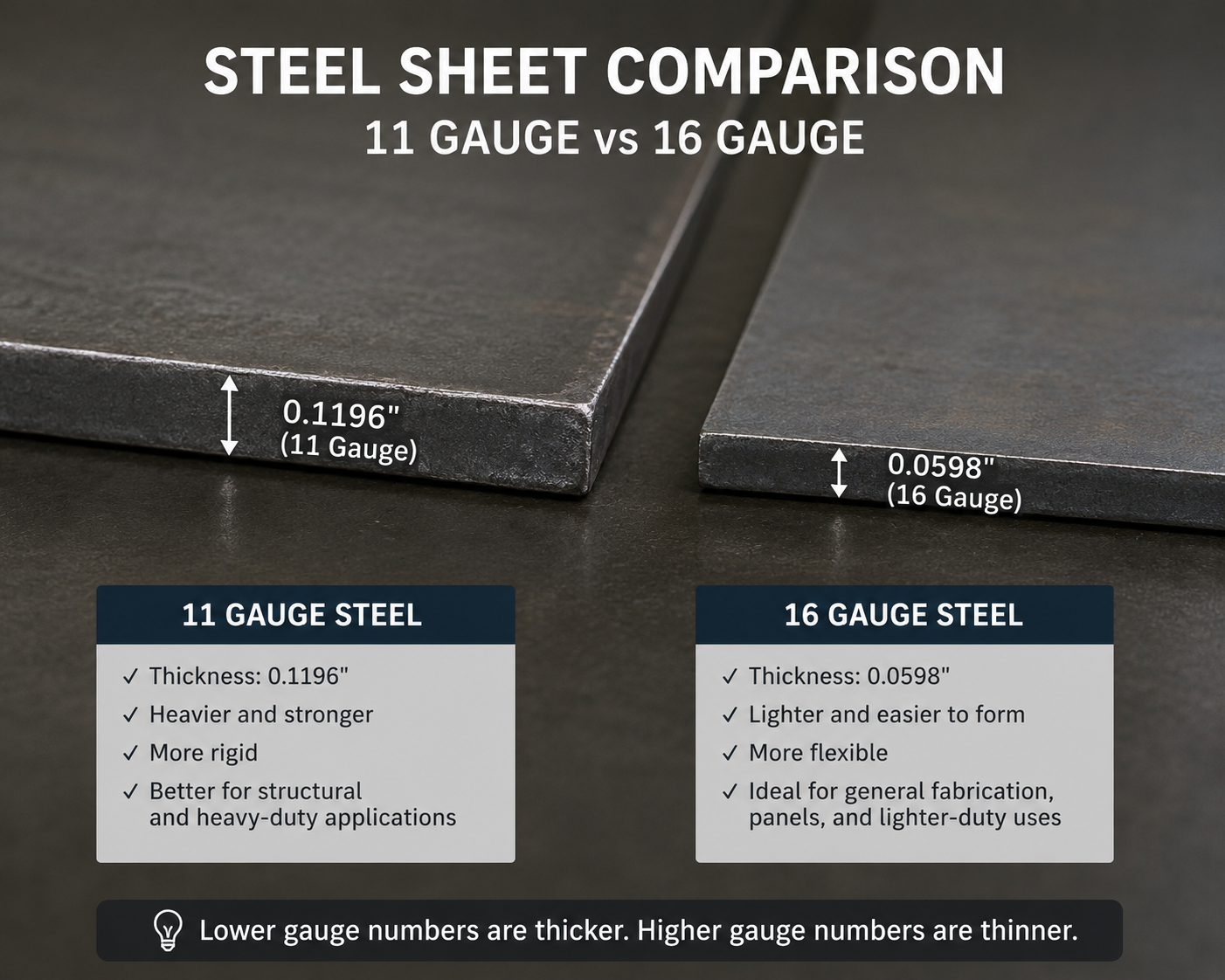
- Lower gauge numbers indicated thicker material.
- Higher gauge numbers indicated thinner material.
As manufacturing technology improved, the actual number of rolling passes became irrelevant, but the gauge numbers had become deeply ingrained throughout the metalworking industry. Instead of abandoning the system, manufacturers standardized each gauge to a specific thickness.
Today, gauge numbers are simply shorthand for standardized material thicknesses.
Why Doesn't the Gauge Match the Actual Thickness?
Unlike fractional or decimal measurements, a gauge number is not a direct measurement. A 10-gauge sheet does not measure 0.010 inches thick, nor does 20-gauge measure 0.020 inches.
Instead, every gauge corresponds to a predetermined decimal thickness.
For example:
| Steel Gauge | Thickness |
|---|---|
| 7 Gauge | 0.1793" |
| 10 Gauge | 0.1345" |
| 11 Gauge | 0.1196" |
| 12 Gauge | 0.1046" |
| 14 Gauge | 0.0747" |
| 16 Gauge | 0.0598" |
| 18 Gauge | 0.0478" |
| 20 Gauge | 0.0359" |
| 22 Gauge | 0.0299" |
As the gauge number increases, the material becomes thinner.
Why Isn't Every Metal the Same Thickness?
One of the biggest sources of confusion is that gauge numbers aren't universal across all metals.
For example, 16-gauge carbon steel, galvanized steel, aluminum, and stainless steel are all different thicknesses.
That's because each industry developed its own gauge standards based on the manufacturing methods used for that particular material.
A few examples:
- 16-gauge carbon steel: 0.0598"
- 16-gauge galvanized steel: 0.0635"
- 16-gauge stainless steel: 0.0625"
- 16-gauge aluminum: 0.0508"
Even though they all carry the same gauge designation, their actual thicknesses differ.
For this reason, engineers and fabricators typically specify both the gauge and the decimal thickness when precision is important.
Why Do People Still Use Gauge?
With today's precision manufacturing, it would seem easier to specify every sheet simply by its decimal thickness. While that does happen on engineering drawings, the gauge system remains popular because it is fast, familiar, and widely understood.
If someone asks for "10-gauge sheet," nearly everyone in the steel industry immediately knows approximately how thick it is without needing to quote a decimal measurement.
Gauge also simplifies inventory. Steel service centers stock many common gauges, making it easier for customers to order standard material sizes without remembering long decimal values.
When Should You Specify Decimal Thickness?
For fabrication, architectural work, laser cutting, or CNC machining, decimal thickness is often preferred because it eliminates any possibility of confusion between different materials.
For example, ordering 0.1345-inch hot rolled steel leaves no room for interpretation, while simply requesting "10 gauge" may require confirming the material type.
Steel Supply Stocks Sheet in Many Gauges
At Steel Supply, we stock sheet and plate in a wide variety of gauges, thicknesses, and materials, including hot rolled steel, cold rolled steel, galvanized steel, stainless steel, aluminum, and more. Whether you know the gauge number, decimal thickness, or metric equivalent, our team can help you select the right material for your project.
The gauge system may have originated during the early days of metal rolling, but it remains one of the most common ways to identify sheet metal today. Once you understand that lower gauge numbers mean thicker material and that different metals use different gauge standards, choosing the right sheet becomes much easier.