Types of Galvanizing - Do you know the difference?
Steel Supply sells a lot of galvanized steel, and for good reason: corrosion resistance.
Galvanizing protects steel by applying a layer of zinc to its surface. That zinc acts as a barrier between the steel and the surrounding environment, helping protect the steel from moisture and corrosion. Even if the coating is scratched or damaged in a small area, the zinc can continue to provide a degree of sacrificial protection to the exposed steel.
But did you know there is more than one way to galvanize steel?
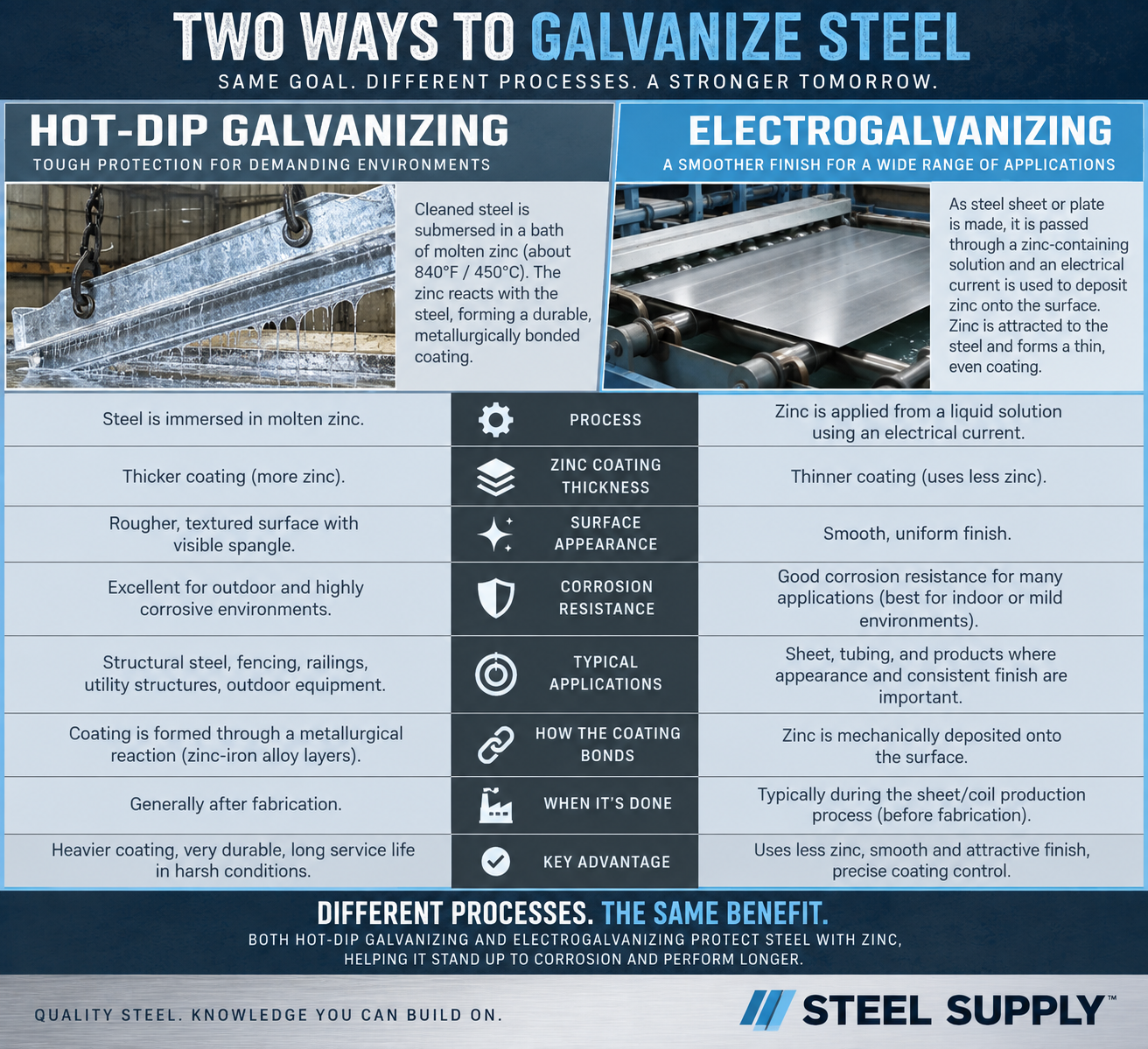
Two common methods are Hot-Dip Galvanizing and Electrogalvanizing, and while both use zinc to protect steel, the way that zinc is applied—and the resulting coating—can be quite different.
Hot-Dip Galvanizing
Hot-dip galvanizing is probably the process most people picture when they think about galvanized steel. After the steel has been properly cleaned and prepared, it is immersed in a bath of molten zinc.
The zinc reacts with the surface of the steel, forming a series of zinc-iron alloy layers topped by a layer of zinc. The result is a relatively thick and durable protective coating.
Because of that heavier coating, hot-dip galvanized steel is commonly used for products that will be exposed to weather, moisture, and other corrosive environments. You have probably seen it on items such as structural components, outdoor railings, fencing, utility structures, and other exterior steel products.
Hot-dip galvanizing typically has a more textured appearance and may show variations in its surface pattern. For many applications, however, appearance takes a back seat to the durability and corrosion protection provided by the heavier zinc coating.
Electrogalvanizing
Electrogalvanizing applies zinc in a very different way.
Instead of dipping the finished steel product into molten zinc, an electrical current is used to deposit zinc onto the surface of the steel from a zinc-containing electrolyte solution. This allows the zinc coating to be applied very evenly and with precise control over its thickness.
Electrogalvanized steel generally has a thinner zinc coating than traditional hot-dip galvanized steel. One of its advantages is its smooth, uniform appearance, which can make it desirable for applications where surface finish is important.
Galvanized sheet or coil can then be formed into products such as tubing. When galvanized steel tubing is manufactured, the material is formed into shape and welded along the seam. Depending on the manufacturing process, the weld area may receive additional zinc treatment to restore corrosion protection where the original coating has been affected by welding.
So, Which Is Better?
Neither process is automatically "better"—they are designed to meet different needs.
Hot-dip galvanizing generally provides a heavier zinc coating and is an excellent choice when long-term corrosion resistance in demanding environments is the priority. Electrogalvanizing uses less zinc and produces a thinner, smoother, and more uniform finish, making it useful where appearance, dimensional consistency, or subsequent fabrication is important.
Either way, the basic idea is the same: protect the steel with zinc and help keep corrosion away.
That's why galvanized steel is used in so many industries and applications—and why Steel Supply stocks a wide variety of galvanized steel products for our customers.
Whether your project calls for galvanized tubing, sheet, structural material, or other steel products, our team can help you find the right material for the job.