Steel Gauge Sizes: Where Did They Come From?
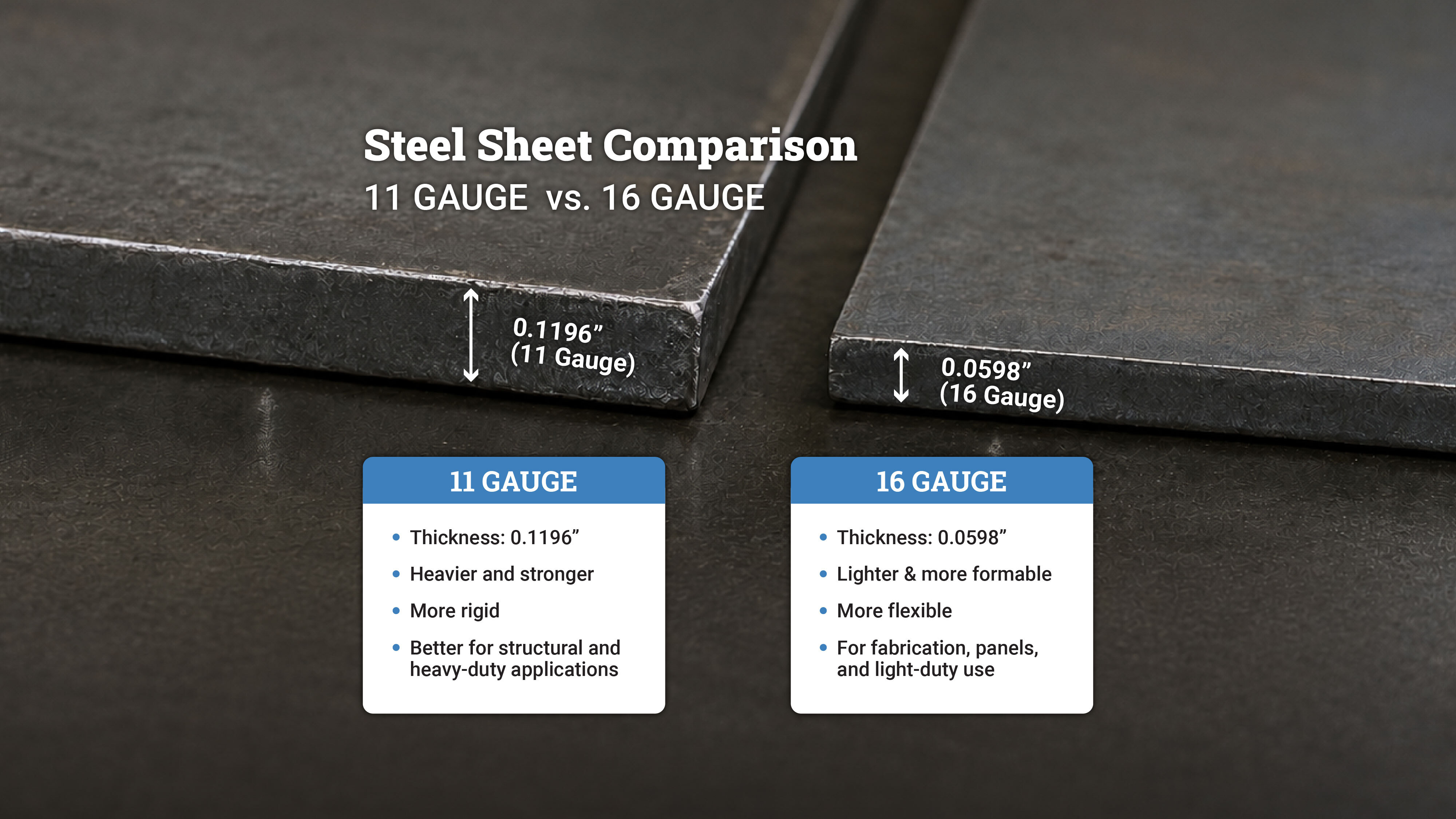
When it comes to sheet metal, gauge numbers don’t work quite the way you might expect.
Why is 11 gauge steel thicker than 16 gauge? And why isn’t 16 gauge steel always the same thickness across different metals?
It seems backward, but there’s a reason. The gauge system dates back more than 150 years and grew out of early metal manufacturing practices rather than a simple mathematical formula.
Where Did Steel Gauge Numbers Come From?
Before modern rolling mills could produce sheet metal to precise thicknesses, metal was made thinner by repeatedly passing it through rollers.
Thicker material required fewer passes, while thinner material required more. Over time, gauge numbers became associated with these different thicknesses.
The important part is simple:
- Lower gauge = thicker metal
- Higher gauge = thinner metal
Manufacturing eventually became much more precise, but the gauge system stuck around. Today, gauge numbers are standardized shorthand for specific material thicknesses.
Why Doesn't Gauge Match the Actual Thickness?
A gauge number is not a direct measurement.
For example, 11 gauge steel is not 0.011 inches thick, and 20 gauge steel is not 0.020 inches thick. Each gauge corresponds to a predetermined decimal thickness.
| 7 Gauge | 0.1793" |
| 10 Gauge | 0.1345" |
| 11 Gauge | 0.1196" |
| 12 Gauge | 0.1046" |
| 14 Gauge | 0.0747" |
| 16 Gauge | 0.0598" |
| 18 Gauge | 0.0478" |
| 20 Gauge | 0.0359" |
| 22 Gauge | 0.0299" |
As the gauge number goes up, the material gets thinner.
Is the Same Gauge the Same Thickness for Every Metal?
No, and this is where gauge sizes can get confusing.
Carbon steel, galvanized steel, stainless steel, and aluminum use different gauge standards. That means two sheets with the same gauge number can have different actual thicknesses.
For example:
- 16 gauge carbon steel: 0.0598"
- 16 gauge galvanized steel: 0.0635"
- 16 gauge stainless steel: 0.0625"
- 16 gauge aluminum: 0.0508"
They're all called 16 gauge, but they're not the same thickness.When exact dimensions matter, it's a good idea to specify the material and decimal thickness, not just the gauge.
Why Do We Still Use Gauge?
Mostly because it's convenient.
Gauge numbers are widely used throughout the metalworking industry and make it easy to discuss common sheet sizes. Ask for 11 gauge steel, for example, and most people in the industry have a good idea of what you need.Gauge also simplifies ordering and stocking common sheet sizes.
When Should You Use Decimal Thickness?
For work where precision matters, such as fabrication, laser cutting, CNC machining, and architectural applications, specifying decimal thickness can eliminate confusion.
For example, asking for 0.1196-inch hot-rolled steel is more precise than asking for 11 gauge, especially when the material type hasn't been specified.
Find the Right Sheet Metal for Your Project
Steel Supply stocks sheet and plate in a variety of gauges, thicknesses, and materials, including hot rolled steel, cold rolled steel, galvanized steel, stainless steel, and aluminum.
Whether you know the gauge, decimal thickness, or metric equivalent, we can help you find the right material for your project.
The main thing to remember is simple: lower gauge means thicker material, higher gauge means thinner material, and gauge thickness can vary by metal type.
Helpful Links
Categories: Resources